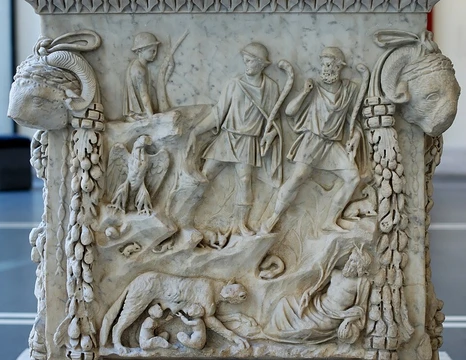
Acron (King of the Caeninenses)
King of the Caeninenses who fought Rome and was slain by Romulus.

EgorovaSvetlana · CC BY-SA 4.0
Acron was the king of the Caeninenses, a people who went to war with Rome after the Rape of the Sabine Women. He is known primarily for his role in the early Roman wars and his death in single combat with Romulus.
- title
- King of the Caeninenses
- died
- Killed in battle by Romulus
- field
- Warfare
- nationality
- Caeninenses
- known_for
- Leading a war against Rome after the Rape of the Sabine Women; slain by Romulus
Lore & Background
Following Acron's death, Romulus marched his army to Caenina, attacked and sacked the town. Romulus dictated that the remaining Caeninenses should relinquish their weapons and established a Roman colony there. He took children as hostages and forced the Caeninenses to destroy large parts of their city. The Caeninenses never challenged Rome again after this conflict.
Reader's Guide
Acron's significance lies in his role as an early opponent of Rome during its legendary founding period. His rejection of Romulus's intermarriage proposal and subsequent alliance with other cities set the stage for a conflict that helped consolidate Roman power. His death in single combat with Romulus, and the harsh treatment of his people afterward, illustrate the brutal methods by which Rome expanded its influence. The story, preserved in later Roman historians such as Livy, Plutarch, and Dionysius of Halicarnassus, is considered mythical due to the lack of contemporary 8th-century BC sources. Nonetheless, it serves as a foundational narrative for Roman military and political dominance, showing how Rome dealt with defiance through war, relocation, and destruction of enemy cities.
Did You Know?
- Acron fought alone against Rome before the Sabine war, not as part of a larger alliance.
- Acron allied with Antemnae, Crustumerium, and Titus Tatius of Cures to fight Rome.
- Romulus slew Acron in a duel and took his armor as spoils.
- After Acron's death, Romulus established a colony at Caenina, rather than forcing many adult male Caeninenses to permanently relocate to Rome.
The Broken Proposal and the Kidnapping
The story of Acron begins not on a battlefield but at a negotiating table. As king of the Caeninenses, he was confronted with a proposal from Romulus, the king of Rome, calling for intermarriage between Roman citizens and the women of Caenina and neighboring towns. Acron refused. The rejection stung Romulus deeply, and in a move that would echo through centuries of Roman legend, the Roman king responded with abduction rather than diplomacy. Latin and Sabine women were seized and compelled into marriage, an event that entered the historical imagination as the Rape of the Sabine Women. For Acron, this was not merely a personal insult but an existential threat to the autonomy and honor of his people. The diplomatic channel that might have bound Rome and Caenina in a peaceful union was shattered, and what followed was a war that would determine the fate of an entire community. The episode underscores how a single rejected proposal could ignite a conflict with consequences far beyond the two kings involved.
Forging the Anti-Roman Alliance
Enraged by the abduction of his people's women, Acron did not respond in isolation. Recognizing that Rome's growing power demanded a broader coalition, he rallied the cities of Antemnae and Crustumerium to his cause and secured the participation of Titus Tatius, king of Cures. This multi-city alliance represented a significant military challenge to the young Roman state. Acron took the initiative by invading Roman territory and setting fire to the surrounding countryside, laying waste to fields and settlements in a campaign of deliberate destruction. The strategy was one of attrition and terror, meant to bleed Rome's resources and morale. Romulus, however, refused to be a passive victim. He counterattacked the raiding forces and, in a remarkable tactical feat, seized the allied encampment. The loss of a fortified base would have been a devastating blow to the coalition's logistics and morale, setting the stage for the decisive confrontation that would end Acron's reign and his life.
The Duel and the Spoils
Acron's story reaches its climax not in a grand set-piece battle but in a one-on-one duel. During the fighting that followed Romulus's seizure of the allied camp, the two kings met in single combat. The outcome was swift and final: Romulus slew Acron. In a gesture that carried enormous symbolic weight in the warrior cultures of the ancient Mediterranean, the Roman king stripped the fallen Acron of his armor and claimed it as personal spoils of war. The taking of an enemy king's armor was not merely a practical act of salvage; it was a public declaration of dominance, a tangible trophy that proclaimed to all witnesses that the king of the Caeninenses had been unmade by the king of Rome. For Acron, the duel represented the ultimate test of a warrior-king's worth, and his death on the field, followed by the despoiling of his regalia, sealed his legacy as a ruler who met his end in direct personal combat against the man who had humiliated his people.
The Sack of Caenina and the Silence That Followed
Acron's death did not end the war; it accelerated its conclusion. Romulus marched his army directly to Caenina and subjected the town to a full assault, sacking it in a display of overwhelming force. The terms he imposed on the surviving Caeninenses were designed to ensure that the threat could never reconstitute itself. The population was ordered to surrender all weapons. Many adult males were compelled to leave their homeland permanently and resettle within Rome itself, effectively dismantling the community's military and civic backbone. Children were taken as hostages, binding the remaining families to Roman authority through the constant threat of their loss. Most devastatingly, the Caeninenses were forced to tear down large portions of their own city, erasing the physical symbols of their independence. The result was total and permanent: the Caeninenses never mounted another challenge against Rome. Whether Acron was a historical figure or a mythological construct, the narrative of his defeat served as a foundational parable of Roman expansion and the subjugation of neighboring Latin communities.
Gallery






Frequently Asked Questions
Who is Acron (King of the Caeninenses)?
Acron was the ruler of the Caeninenses, an Italic tribe that clashed with early Rome during the legendary founding era. He is remembered almost entirely as a wartime adversary who faced Romulus on the battlefield.
What role does Acron play in Roman mythology?
His function in the mythic narrative is that of a hostile neighboring king who leads his people into armed conflict against the young city of Rome. He serves as one of the early external threats Romulus had to overcome to secure the city's borders.
How does Acron's story end?
Acron meets his death in single combat, where he is personally slain by Romulus on the battlefield. His killing by the Roman founder is the defining and final moment of his brief mythic career.
Why is Acron important in early Roman legend?
He represents the broader pattern of small Italic communities that Rome had to subdue during its formative years. His defeat by Romulus reinforces the founding narrative of Rome as a growing military power asserting dominance over neighboring tribes.
What event triggered the war between the Caeninenses and Rome?
The conflict arose in the aftermath of the Rape of the Sabine Women, an incident that destabilized relations between Rome and surrounding Italic peoples. The Caeninenses, under Acron's leadership, joined the broader hostilities that followed that episode.
More in Roman mythology 1-24
Spotted an error? Know more?
This is a living reference — every entry is fact-audited, and reader corrections feed straight into our audit queue. Suggest an edit · See this site's audit record