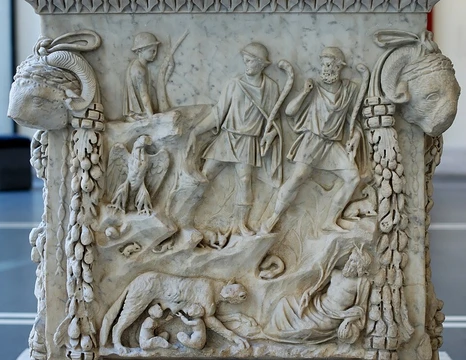
Crinisus
Sicilian river god who fathered Segesta's founder as a dog.

Vincent A. Vos · CC BY 4.0
Crinisus (or Crimisus) is the god of the Sicilian river Crinisus in Greek and Roman mythology, best known from Virgil's Aeneid and subsequent Roman texts. He is most significant for fathering Acestes (or Egestus) with a Trojan woman while in the form of a dog, a union that led to the founding of the city of Segesta in Sicily. The myth is reflected in ancient Segestan coinage, which often depicts a dog and a woman's head, traditionally associated with Crinisus and the eponymous Segesta.
- field
- Mythology
- known_for
- Fathering Acestes, founder of Segesta, while in the form of a dog
- nationality
- Greek/Roman (Sicilian river god)
Lore & Background
The earliest known version of the myth appears in Lycophron's Alexandra, where the River Crimissus, in the likeness of a dog, took one of the three daughters of Phoenodamas as his bride after they were sent to Sicily to die of exposure. Their unnamed son became the settler and founder of three places—later commentators identify these as Segesta, Eryx, and Entella—and guided Elymus from Dardanus to western Sicily. Virgil's Aeneid briefly describes Acestes as 'born of a Trojan mother to the river god Crinisus,' and Gaius Julius Hyginus also calls Acestes 'son of the river Crinisus.'
Servius the Grammarian's commentary on the Aeneid provides the most complete version: after Neptune and Apollo built Troy's walls and were refused payment, Neptune sent sea monsters, and Apollo decreed that noble daughters be attacked. Fearing for his daughter Egesta, Hippotes (or Isostratus) sent her away by ship, which winds from the River Crimissus carried to Sicily. Crimissus turned into a bear or a dog and mated with her, producing Egestus, who founded the Trojan city of Egesta (later Segesta). Servius notes that Virgil used poetic license to change the river god's name from Crimissus to Crinisus and his son's name from Egestus to Acestes.
In contrast, Claudius Aelianus' Varia Historia states that the people of Segesta honor Porpax, Crimisus, and Telmessus, while Dionysius of Halicarnassus offers a different version where Acestes' father was a youth of distinguished family who accompanied and married Acestes' mother in Sicily.
Reader's Guide
Crinisus holds significance primarily as a mythological figure whose story is tied to the foundation of Segesta, a major city in western Sicily. The myth, preserved in multiple ancient sources, shows how Greek and Roman writers used local river gods to explain the origins of cities and their populations. The recurring motif of Crinisus transforming into a dog to father a son reflects a common mythological theme of divine beings taking animal forms to interact with mortals.
The connection between the myth and Segestan coinage from 475–390 BCE provides a rare link between literary tradition and material culture. Coins featuring a dog on one side and a woman's head on the other have traditionally been associated with Crinisus and the eponymous Segesta, though scholars debate whether the woman represents a local nymph, Artemis, or Aphrodite Urania. The spread of these coin designs to other Sicilian cities like Eryx, Panormus, and Motya indicates the cultural influence of Segesta and its myths.
Crinisus's legacy is also evident in the variant traditions recorded by different authors, from Lycophron to Servius, showing how foundation myths evolved over time. The river god's story, though minor in the broader pantheon, illustrates how ancient peoples used mythology to create identity and history for their communities.
Did You Know?
- According to Servius, Virgil used poetic license to change the river god's name from Crimissus to Crinisus and his son's name from Egestus to Acestes.
- Segestan coins from 475–390 BCE often depict a dog on one side and a woman's head on the other, traditionally associated with Crinisus and the eponymous Segesta.
- Lycophron's Alexandra contains the first known version of the myth, where the River Crimissus took one of the daughters of Phoenodamas as his bride in the form of a dog.
- Claudius Aelianus wrote that the people of Segesta honored Porpax, Crimisus, and Telmessus, though he does not specify that they were honored 'in the form of men.'
The Myth Across Ancient Sources
The story of Crinisus and his Trojan bride surfaces across a remarkable range of ancient texts, each lending a distinct flavor. The earliest surviving account, Lycophron's Alexandra, frames the episode within Troy's siege: the king, facing a sea monster's assault, ordered the daughters of Phoenodamas abandoned to wild beasts. They reached Sicily, survived, and raised a shrine to Aphrodite. There the river god, in canine form, claimed one of the women as his bride and sired a son destined to found three settlements. Virgil's Aeneid compresses the whole episode into a single line, naming the child Acestes and his father Crinisus, while Hyginus echoes the same parentage. Servius the Grammarian, in his Aeneid commentary, supplies the fullest narrative: Neptune's vengeance for unpaid wages, the decree against noble daughters, the daughter Egesta shipped to Sicily on winds the river sent, and the god's shift into a bear or dog. Servius also flags Virgil's deliberate renaming of Crimissus to Crinisus and Egestus to Acestes as poetic license. Aelianus and Dionysius of Halicarnassus offer further variants, the latter replacing the divine father with a mortal youth of noble birth who accompanied the woman from Troy and married her upon arrival.
The Founding of Segesta and Its Trojan Heritage
The son of Crinisus—called Acestes by Virgil and Hyginus, Egestus by Servius—stands at the center of Segesta's origin story. In Lycophron's telling, this child becomes the 'settler and founder of three places,' a title scholars generally read as referring to Segesta, Eryx, and Entella, and he is credited with guiding Elymus from Dardanus to western Sicily. Servius narrows the focus: the boy, Egestus, establishes a single Trojan city on Sicilian soil and names it after his mother, Egesta, a name that later evolved into Segesta. The city's identity was inseparable from its Trojan roots. Lycophron closes his passage by noting that the people of Aegesta continued to mourn the fall of Troy long after the destruction, a poignant reminder that the founding was not merely a political act but an emotional one, a community built around collective grief and displacement. The mother, a daughter of Phoenodamas in Lycophron or of Hippotes in Servius, carried the weight of that heritage into a new land, and her name became the city's own.
The Numismatic Legacy
Perhaps the most tangible trace of the Crinisus myth survives in the coinage of Segesta. Beginning after the Carthaginian defeat at Himera in 480 BCE, the city struck didrachmas from 475 BCE bearing a dog sniffing the ground on one face and a woman's head on the other. Over the following decades the canine image evolved: by 460 BCE the dog looked back, by 455 it faced forward, and by 430 it followed a scent. Around 415–400 BCE the designs grew more elaborate, introducing a standing dog with a shell alongside a gorgoneion or solar head, paired with a three-quarter woman's head in a laurel wreath. From 412/410 to 400 BCE, hunting scenes appeared—a dog carrying a deer's head, a dog pursuing a hare, and a hunter sometimes identified as Crinisus walking with his dog. Numismatists have linked these increasingly martial motifs to territorial tensions between Segesta and Selinunte. The dog-and-woman type spread to Eryx by 460 BCE and to Panormus and Motya from 430 BCE. Scholars debate the woman's identity: traditionally the eponymous Segesta, though Karl Galinsky argues for Artemis, and Aphrodite Urania has also been proposed.
The Mother's Odyssey
Behind the river god's brief appearance lies a far more human drama: the journey of a Trojan woman to Sicily. In Lycophron, the daughters of Phoenodamas are condemned to die of exposure and be devoured by beasts, yet they survive the crossing and build a great shrine to Aphrodite in gratitude. Servius elaborates: after Neptune and Apollo built Troy's walls and were refused their fee, Neptune unleashed sea monsters and Apollo decreed that noble daughters be attacked. Fearing for his daughter Egesta, Hippotes—or Isostratus—sent her away by ship, and it was the winds of the River Crimissus that carried her to Sicily. Dionysius of Halicarnassus strips the story of its divine machinery entirely, presenting the father as a distinguished young man who fell in love with the woman, accompanied her from Troy, and married her once they reached the island. In every version, the mother's survival and her naming of the city after herself anchor the myth in a very personal act of resilience, transforming a tale of divine predation into one of endurance and identity.
Gallery
Frequently Asked Questions
Who is Crinisus in Roman mythology?
Crinisus is a deity of the Sicilian river Crinisus, attested primarily in Virgil's Aeneid and later Roman literary sources. He belongs to the broader Greek and Roman tradition of personifying rivers as divine figures.
What is Crinisus's most well-known story?
He is best remembered for fathering Acestes (also called Egestus) after taking the shape of a dog and mating with a Trojan woman. This union is the mythic origin of the city of Segesta in Sicily.
What role does Crinisus play in the founding of Segesta?
As the divine father of Acestes, the legendary founder of Segesta, Crinisus functions as a progenitor figure in the city's origin narrative. His story gave Segesta a mythological lineage tied to both the Trojan War and local Sicilian geography.
How is Crinisus depicted on ancient Segestan coinage?
Coins minted at Segesta in antiquity often feature the image of a dog paired with a woman's head. These designs are traditionally interpreted as visual references to the Crinisus-and-Trojan-woman legend that explains the city's founding.
Where does Crinisus appear in classical literature?
His most prominent literary appearance is in Virgil's Aeneid, where the Sicilian river god is mentioned in connection with the founding of Segesta. He also surfaces in later Roman texts that expand on the Trojan-Sicilian settlement traditions.
More in Roman mythology 1-24
Spotted an error? Know more?
This is a living reference — every entry is fact-audited, and reader corrections feed straight into our audit queue. Suggest an edit · See this site's audit record