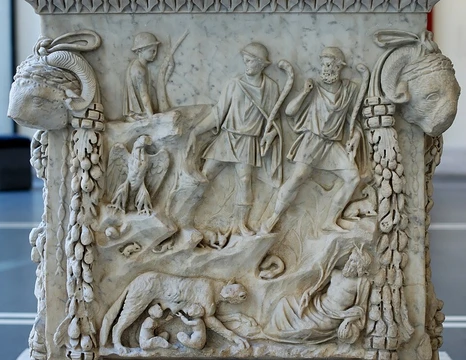
De Divinatione
Cicero's dialogue on Roman divination, skepticism, and superstition.

drukkerij: Broenneri, H.L. · CC BY-SA 3.0
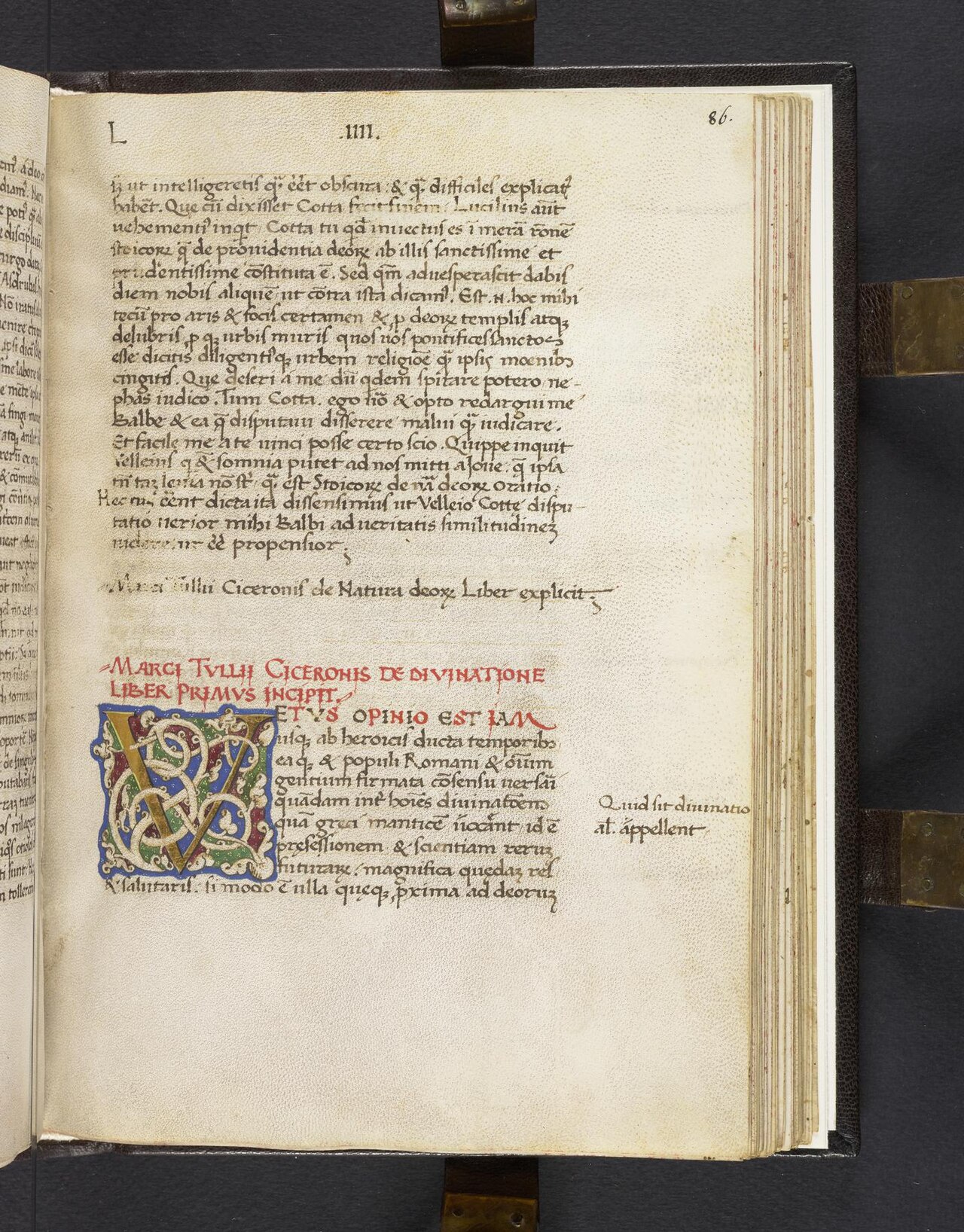
De Divinatione, meaning "Concerning Divination" in Latin, is a philosophical dialogue by Marcus Tullius Cicero, composed in 44 BC and focused on the practice of divination in ancient Rome. The text is divided into two books, structured as a conversation between Cicero and his brother Quintus. Book I presents Quintus’s defense of divination, rooted in his Stoic beliefs, while Book II contains Cicero’s counterarguments from his Academic skeptic perspective. Cicero categorizes divination into two types: the "inspired" kind, associated with madness, dreams, and frenzy, and the interpretive kind, which includes practices like haruspicy, extispicy, augury, astrology, and oracles.
The work is often seen as a companion piece to Cicero’s *De Natura Deorum*. Cicero claims to recount a discussion held at Tusculum with his brother. In the first book, Quintus argues that divination has been widespread across all peoples, and that the inability to explain how or why certain predictions occur does not invalidate them—just as medicine remains an art despite not always curing. He distinguishes two forms of augury: one based on deduction and skill, which is an art, and another, seen in dreams or frenzy, which is "devoid of art." Quintus provides numerous examples of omens, dreams, and portents, including two notable dreams—one experienced by Cicero himself and another by Quintus—and questions whether Greek historical accounts of omens should be dismissed as fables.
In the second book, Cicero refutes auguries, auspices, astrology, lots, dreams, and all forms of omens and prodigies. He argues, for instance, that his dream of Marius during exile arose from frequent thoughts of him, not from any prophetic cause, and that during sleep the soul is relaxed, allowing remnants of waking thoughts to move freely. He points to a case where an unnamed interpreter and Antipho gave opposite interpretations of an Olympic runner’s dream—one predicting victory, the other defeat—to show that divination relies on the interpreter’s bias, not logic or skill. Cicero also challenges Cratippus’s certainty about divination, asserting that prophecies come true only by luck or chance, and that mythical oracles are mere stories. He criticizes the obscurity of dream messages and omens, questioning why gods would warn mortals in such confusing ways. The second book ends with a chapter condemning supersti
- author
- Marcus Tullius Cicero
- year_written
- 44 BC
- language
- Latin
- genre
- Philosophical dialogue
- subject
- Ancient Roman divination
- structure
- Two books
Lore & Background
De Divinatione is set in two books, with Cicero (speaking mostly in Book II) and his brother Quintus as interlocutors. Book I presents Quintus' apologetics in favor of divination, in line with his Stoic beliefs, while Book II contains Cicero's refutation from his Academic skeptic standpoint. Cicero divides divination into the 'inspired' type (Latin furor, Greek mania, 'madness'), especially dreams, and the type occurring via skill of interpretation (haruspicy, extispicy, augury, astrology, and other oracles). The dialogue may be considered a supplement to Cicero's De Natura Deorum.
Reader's Guide
De Divinatione is significant as a primary source for understanding Roman religious practices and the intellectual debates surrounding divination. Cicero's work preserves arguments for and against various forms of divination, including augury, astrology, and dream interpretation, using historical and mythical examples. The dialogue also provides insight into Stoic and Academic skeptic philosophical positions. Cicero's refutation of divination, including his critique of superstition, has influenced later discussions on the rationality of religious practices. The work remains a key text for scholars of Roman religion, philosophy, and the history of science.
Did You Know?
- The dialogue includes a fragment of Cicero's poem on his own consulship.
- Cicero argues that dreams during sleep arise from remnants of waking thoughts, not divine omens.
- The work contains the famous quote: 'Nothing so absurd can be said that some philosopher had not said it.'
- Cicero cites Cato's remark that he was surprised one haruspex did not laugh when seeing another.
Philosophical Architecture of the Dialogue
De Divinatione is structured as a two-book philosophical dialogue set at Tusculum, where Cicero claims to recount a conversation with his brother Quintus. The work functions as a companion piece to De Natura Deorum, extending Cicero's exploration of religious and metaphysical questions into the specific domain of prophetic practice. The intellectual engine of the dialogue is the tension between two philosophical traditions: Quintus champions divination from a Stoic perspective, treating it as a rational art grounded in observable patterns, while Cicero marshals Academic skepticism to dismantle every pillar of his brother's case. Book I gives Quintus the floor to catalog the various species of divination and offer arguments in their favor, while Book II hands the baton to Cicero, who systematically refutes augury, auspices, astrology, lots, dreams, and prodigies. The dialogue also includes a fragment of Cicero's own poem on his consulship, adding a personal literary layer to the philosophical exchange.
Taxonomy of Prophetic Arts
Cicero and Quintus devote considerable attention to classifying the many forms that divination can take in the Roman world. They distinguish between what they call the inspired variety, rooted in furor or mania, a kind of ecstatic madness, and the skill-based variety, which depends on trained interpretation. The inspired category encompasses dreams and frenzied prophetic utterances, while the skill-based category includes haruspicy, extispicy, augury, astrology, and consultations of various oracles. Quintus further subdivides augury itself into two species: one driven by deduction and technical expertise, which he regards as a genuine art, and another that foresees events through dreams or ecstatic states, which he concedes is devoid of art. This careful taxonomy allows the dialogue to address each method on its own terms, making Cicero's subsequent refutations in Book II more targeted and philosophically precise. The classification also reveals how Roman religious practice was far more diverse and systematic than later readers might assume.
Divination on the Battlefield
One of the most vivid threads in De Divinatione is the extended debate over whether prophetic signs can reliably guide military strategy. Quintus marshals a catalogue of historical and mythological cases: Publius Claudius, whose Roman fleet was largely destroyed in the First Punic War; Agamemnon, who lost ships after ignoring unfavorable auguries; and Gaius Flaminius, who in the Second Punic War defied three separate warnings from augurs to delay engagement with Hannibal and was killed along with his army. Cicero counters with equally pointed examples of divination leading to poor decisions, such as King Prusias of Anatolia refusing Hannibal's counsel to go to war because the entrails forbid, and the augurs who sent false assurances of victory to Pompey during the civil war against Caesar. The debate even extends to the seemingly trivial sign of a cock's crow in Lebadia, where Boeotian bards claimed victory for Thebes based on the bird's call, while other philosophers argued cocks crow spontaneously and cannot be trusted as oracles.
Legacy and the Question of Superstition
De Divinatione occupies a distinctive place in the surviving literary record as one of the principal ancient sources for understanding how Roman religious practice actually functioned in daily and political life. Beyond its value as a window into Roman piety, the dialogue is recognized as an early articulation of what we might call the conception of scientificity in classical antiquity, reflecting Cicero's insistence that claims must be tested against reason and experience rather than accepted on the authority of tradition. The final chapter of Book II turns its attention to the broader social danger of superstition, and Cicero frames his entire refutation as an effort to uproot that danger from Roman culture. The work also preserves memorable aphorisms, including the observation that no statement is so absurd that some philosopher has not already made it, and the anecdote about Cato's bemusement at one haruspex failing to laugh at another. These details, woven through the philosophical argument, give the dialogue a richness that has kept it in continuous scholarly and popular discussion for nearly two millennia.
Gallery
Frequently Asked Questions
What is De Divinatione?
It is a two-book philosophical dialogue composed by Cicero in 44 BC that examines the practice and legitimacy of divination in ancient Rome. Rather than a myth or religious narrative, it takes the form of a structured intellectual debate.
Who wrote De Divinatione and in what year?
Marcus Tullius Cicero authored the work in 44 BC, writing it in Latin. It is classified as a philosophical dialogue rather than a piece of traditional Roman myth or epic poetry.
Who are the two speakers in De Divinatione?
The text is staged as a conversation between Cicero and his younger brother Quintus. Quintus defends divination from a Stoic perspective, while Cicero counters with arguments drawn from Academic skepticism.
What two kinds of divination does Cicero distinguish in the dialogue?
He separates divination into an 'inspired' type linked to madness, dreams, and frenzy, and an interpretive type based on reading external signs. This binary framing organizes the brothers' entire debate.
Why is De Divinatione significant in Roman intellectual history?
It captures the live tension between Stoic confidence in cosmic signs and Academic doubt about whether such signs can ever be reliably interpreted. The work remains a key primary source for understanding how educated Romans debated prophecy, omens, and superstition.
More in Roman mythology 1-24
Spotted an error? Know more?
This is a living reference — every entry is fact-audited, and reader corrections feed straight into our audit queue. Suggest an edit · See this site's audit record