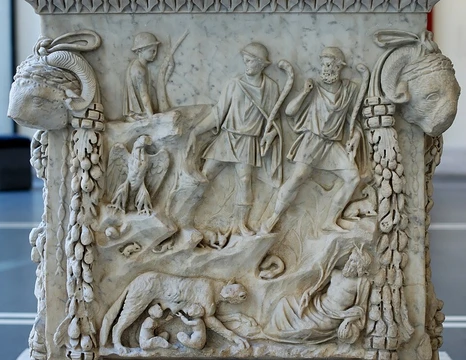
Roman mythology
Roman myths blend history, politics, and divine destiny.

Wikimedia Commons · Public domain
Roman mythology is the body of myths of ancient Rome as represented in the literature and visual arts of the Romans, and is a form of Roman folklore. It draws from the mythology of the Italic peoples and shares mythemes with Proto-Indo-European mythology, and also draws on Greek mythology, primarily during the Hellenistic period of Greek influence and through the Roman conquest of Greece. The Romans usually treated their traditional narratives as historical, even when they have miraculous or supernatural elements, and the stories are often concerned with politics and morality, heroism, and how an individual's personal integrity relates to their responsibility to the community or Roman state.
- field
- Mythology, Folklore
- nationality
- Roman
- known_for
- Founding myths of Rome, political and moral narratives, identification of Roman gods with Greek deities
- major_sources
- Aeneid (Virgil), Livy's early history, Ovid's Fasti, Propertius' elegies
Lore & Background
Roman mythology encompasses the traditional narratives of ancient Rome, often treated as historical by the Romans themselves. These stories focus on human actors with occasional divine intervention and a pervasive sense of divinely ordered destiny. Key founding myths include the Trojan prince Aeneas, cast as husband of Lavinia and forebear of Romulus and Remus, making the Trojans mythical ancestors of the Roman people. Other characteristic myths are political or moral, such as the Rape of the Sabine women, the story of Lucretia prompting the overthrow of the monarchy, and Horatius at the bridge emphasizing individual valor.
Reader's Guide
Roman mythology's significance lies in its role as a foundation for Roman identity and governance, with narratives that explore themes of freedom, republicanism, and the dangers of tyranny. The Romans identified their own gods with those of the ancient Greeks and reinterpreted Greek myths under Roman names, a tradition that through Latin literature influenced European culture from the Middle Ages through the Renaissance to modern fiction and movies. The versions of Greek myths in Ovid's Metamorphoses became canonical. Roman myth also informed religious practices, with ritual and cultus primary, and priestly literature among the earliest Latin prose. The stories still matter, as they mattered to Dante, Shakespeare, and the founding fathers of the United States.
Did You Know?
- Roman mythology draws from the mythology of the Italic peoples and shares mythemes with Proto-Indo-European mythology.
- The Romans identified their own gods with those of the ancient Greeks and reinterpreted myths about Greek deities under the names of their Roman counterparts.
- The Aeneid of Virgil and the first few books of Livy's history are major sources for Roman myth.
- The Tarpeian Rock is associated with a myth explaining why it was used for the execution of traitors.
The Trojan Roots of Roman Identity
The founding mythology of Rome wove together indigenous Italic legend with imported Greek heroic material to construct a lineage linking the city's origins to the fall of Troy. In the most influential versions, the Trojan prince Aeneas became the husband of Lavinia, daughter of King Latinus, who served as the patronymical ancestor of the Latini people. Through this carefully constructed genealogy, Aeneas was positioned as the forebear of Romulus and Remus, and by extension the Trojans were adopted as the mythical ancestors of the entire Roman people. The Aeneid of Virgil and the opening books of Livy's history remain the best surviving sources for these narratives. What makes this tradition remarkable is its self-awareness: scholars note that Greek heroic material was grafted onto native Roman stock at an early date, producing a convoluted revisionist genealogy that served political and cultural purposes. The Etruscan city of Corythus was even cast as the cradle of both Trojan and Italian civilization, further entangling the layers of origin. This mythic framework gave Rome a destiny narrative that transcended mere local legend.
Myths as Civic Mirror
Unlike the Greek tradition, where narratives of divine activity sat at the heart of religious belief, Roman mythology was characteristically political and moral in orientation. The stories the Romans told about themselves were less concerned with cosmogony or theology and more focused on how individual integrity related to responsibility toward the community and the state. Heroism, personal sacrifice, and the tension between authority and tyranny recur throughout. Lucretia's self-sacrifice prompted the overthrow of the monarchy and the birth of the Republic. Horatius defended a bridge through sheer individual valor. Mucius Scaevola thrust his own hand into a fire to demonstrate loyalty. Cloelia escaped her captor Lars Porsena but voluntarily returned to preserve a peace treaty and save fellow hostages. Numa Pompilius, the Sabine second king, established Rome's legal and religious institutions through his relationship with the nymph Egeria. Even the Tarpeian Rock, used for executing traitors, carried a mythic explanation. These narratives, as T. P. Wiseman observes, still resonate with questions about citizenship, republicanism, and the corruption of well-meaning power.
The Greek Inheritance and the Classical Canon
Roman mythology did not develop in isolation. From as early as Rome's protohistory, and intensifying during the Hellenistic period and the Roman conquest of Greece, Greek mythological material profoundly shaped Roman narrative tradition. Roman authors imitated Greek literary models, and the Romans systematically identified their own deities with their Greek counterparts, retelling myths about Greek gods under Roman names. This process of cultural translation meant that the amalgamated tradition of Greek and Roman mythology—what we now call classical mythology—was disseminated across Europe through Latin literature from the Middle Ages through the Renaissance into modern fiction and film. Crucially, Roman interpretations often exerted greater influence on how myths were narrated and depicted visually than the original Greek sources. Ovid's Metamorphoses, composed during the reign of Augustus, became the canonical version for centuries, shaping European artistic and literary imagination far more than any single Greek text. The Fasti, a six-book poem organized around the Roman religious calendar, and Propertius's fourth book of elegies further enriched this tradition. Scenes from these myths proliferated in Roman wall painting, coinage, and sculptural reliefs, embedding the stories into the visual culture of the empire.
Ritual, Priesthood, and the Question of Native Myth
Because ritual occupied the central position in Roman religion that myth held for the Greeks, some scholars have questioned whether the Romans possessed a substantial native mythology at all. This skeptical view is largely a product of nineteenth-century Romanticism and classical scholarship, which privileged Greek civilization as more authentically creative. Yet the Roman tradition was rich in historical legends concerning the city's foundation and rise, narratives that centered on human actors with only occasional divine intervention but a pervasive sense of divinely ordered destiny. In Rome's earliest period, history and myth maintained a mutual and complementary relationship. The religious infrastructure was maintained by priestly bodies: the College of Pontiffs and the augurs produced libri and commentarii containing procedures, prayers, and rulings on religious law. This material was often classified as occultum genus litterarum, an arcane literary form accessible by definition only to priests, though at least some of it was available to the senate. Prophecies concerning Rome's destiny surfaced fortuitously at critical historical junctures, discovered in the enigmatic Sibylline books. Roman myth, then, was less a free-floating narrative world and more an embedded component of civic ritual and institutional memory.
Gallery


Frequently Asked Questions
What is Roman mythology?
Roman mythology is the body of traditional stories and beliefs held by ancient Romans, covering their gods, founding legends, and moral narratives. It functions as a form of Roman folklore that weaves divine intervention into political history and ethical instruction.
How does Roman mythology differ from Greek mythology?
Although Roman myths share many narrative patterns with Greek ones—especially after the Hellenistic period and Rome's conquest of Greece—Roman tales tend to present supernatural events as historical fact and stress civic duty, political legitimacy, and moral lessons over purely divine drama.
What are the key primary sources for Roman mythology?
The most important texts include Virgil's Aeneid, Livy's early Roman history, Ovid's Fasti, and Propertius' elegies. Together these works preserve the founding legends, the pantheon of gods, and the ritual calendar that shaped Roman religious life.
What are the founding myths of Rome?
The central founding narratives trace Rome's origin to Aeneas, a Trojan hero who fled to Italy, and to the twins Romulus and Remus, raised by a she-wolf and credited with establishing the city. These stories linked Roman political authority to divine destiny and heroic ancestry.
Why did Romans identify their gods with Greek deities?
During the Hellenistic period of Greek cultural influence and after Rome's military conquest of Greece, Romans systematically paired their own gods with Greek counterparts—Jupiter with Zeus, Minerva with Athena, and so on. This syncretism let them absorb Greek literary and artistic traditions while keeping the distinct character of their native deities.
More in Roman mythology 1-24
Spotted an error? Know more?
This is a living reference — every entry is fact-audited, and reader corrections feed straight into our audit queue. Suggest an edit · See this site's audit record