Casa Romuli
Legendary hut of Rome's founder, preserved for centuries.

Giuseppe Vasi · Public domain
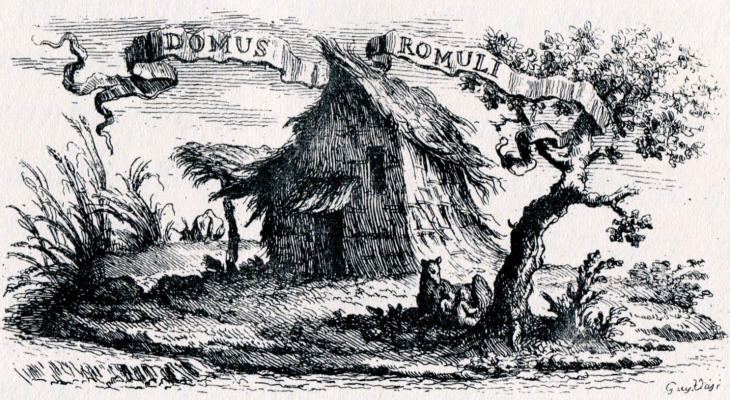
The Casa Romuli, or tugurium Romuli, was believed to be the home of Romulus, the legendary founder and first king of Rome, who supposedly lived from 771 to 717 BC. This hut stood on the southwestern corner of the Palatine Hill, on the slope descending toward the Circus Maximus, close to the so-called Steps of Cacus. It was a simple, one-room Latin peasant dwelling, with a thatched roof and walls made of wattle and daub—a style replicated in miniature by the distinctive funerary urns of the Latial culture, which flourished from roughly 1000 to 600 BC.
In Roman records, the hut was repeatedly damaged by fire and storms over the centuries, but each time it was carefully restored to its original form. A fire in 38 BC occurred during a ceremony held inside by the pontifices, the College of High Priests, likely a burnt sacrifice to Romulus in his deified form as the god Quirinus; the altar fire presumably got out of control. The last recorded fire was in 12 BC, following the death of Marcus Vipsanius Agrippa, the right-hand man of Emperor Augustus (who ruled from 27 BC to AD 14). On that occasion, crows supposedly dropped burning meat snatched from an altar onto the thatched roof, igniting it. Some have speculated that a later structure on the Palatine, the tugurium Faustini mentioned during the reign of Constantine I (AD 312–337), was actually the still-surviving Casa Romuli.
A second Casa Romuli is noted in classical sources, located on the Capitoline Hill and likely a replica of the original. It is last mentioned in AD 78. To date, archaeologists have not definitively linked the Casa Romuli to any surviving remains. A strong candidate, however, is the largest of a group of dwellings whose foundations were uncovered in the right location during 1946 excavations. These foundations were cut into tufa bedrock, forming an oval perimeter measuring 4.9 by 3.6 meters. Six post-holes arranged in a circle, with one in the center, likely held the supports for the walls and roof. Organic material from the site has been dated to the Italian early Iron Age, around 900 to 700 BC.
- type
- Legendary dwelling
- location
- South-western corner of the Palatine Hill, Rome
- associated_figure
- Romulus (traditionally reigned from 753 BC)
- construction_type
- Single-roomed peasants' hut with straw roof and wattle-and-daub walls
- known_for
- Reputed home of Rome's founder, repeatedly restored after fires
- archaeological_candidate
- Largest of a group of dwellings unearthed in 1946, ovoid 4.9m x 3.6m, dated to Italian early Iron Age (ca. 900–700 BC)
Lore & Background
Over the centuries, the casa was repeatedly damaged by fire and storms, but carefully restored to its original state on each occasion. Destruction by fire is recorded for 38 BC, as a result of a ceremony held inside the casa by the pontifices ("College of High Priests"), presumably a burnt sacrifice to Romulus in his deified state as the god Quirinus, during which the altar-fire probably ran out of control. The last recorded fire was in 12 BC, on the death of Marcus Vipsanius Agrippa, right-hand man of the first Roman emperor, Augustus (ruled 27 BC – AD 14). On this occasion, the casa was apparently set on fire by some crows which dropped pieces of burning meat, again snatched from an altar, onto the thatched roof.
It has been speculated that a tugurium Faustini ("the cottage of Faustinus") on the Palatine recorded in the time of the emperor Constantine I (ruled
Reader's Guide
The Casa Romuli holds significance as a tangible link to Rome's foundation myth, embodying the humble origins of the city's legendary founder. Its repeated restoration after fires—recorded in 38 BC and 12 BC—demonstrates the enduring reverence Romans held for this site, even as the city grew into an empire. The structure's design, a single-roomed Latin peasant hut with straw roof and wattle-and-daub walls, reflects the material culture of the Latial period (ca. 1000–600 BC), as seen in miniature funerary urns. The uncertainty over its exact location, with a possible replica on the Capitoline Hill and a later reference to a "cottage of Faustinus," highlights the challenges of archaeological identification. The 1946 excavation of a dwelling with ovoid foundations and post-holes, dated to the early Iron Age, offers a plausible candidate but remains unconfirmed. This ambiguity underscores the blend of history and legend in Rome's early narrative, making the Casa Romuli a symbol of both archaeological inquiry and cultural memory.
Did You Know?
- The Casa Romuli was repeatedly damaged by fire and storms but carefully restored to its original state each time.
- A fire in 38 BC occurred during a ceremony by the pontifices, presumably a burnt sacrifice to Romulus as the god Quirinus.
- In 12 BC, crows reportedly set the thatched roof on fire by dropping pieces of burning meat snatched from an altar.
- A second Casa Romuli on the Capitoline Hill is last mentioned in AD 78.
Architecture & Cultural Roots
The Casa Romuli, also called the tugurium Romuli, was traditionally identified as the humble abode of Romulus, the mythic founder and first king of Rome (conventionally dated 771–717 BC). It stood on the south-western shoulder of the Palatine Hill, at the point where the slope descends toward the Circus Maximus, in the vicinity of the so-called Steps of Cacus. Far from being a grand structure, it was a single-chambered dwelling of the kind associated with Latin peasant life: walls of woven wattle filled with daub, topped by a thatched straw roof. This very type of construction survives in miniature on the distinctive funerary urns of the Latial culture, a ceramic tradition spanning roughly 1000 to 600 BC, which gives modern readers a tangible sense of what the hut may have looked like. The building's deliberate simplicity was part of its meaning. In a city that would later boast marble temples and imperial palaces, preserving a tiny wattle hut on the Palatine served as a constant reminder that Rome's origins were modest, pastoral, and rooted in the landscape of the Latin plain.
A Sacred Site Marked by Fire
The casa occupied a unique position in Roman religious practice. The pontifices, the College of High Priests, performed ceremonies within its walls, and the structure was treated with extraordinary care: every time fire or storm destroyed it, the authorities saw to it that the hut was rebuilt to its original form. Two fires are recorded in the ancient sources with particular vividness. In 38 BC, a burnt sacrifice offered to Romulus in his deified capacity as the god Quirinus went wrong; the altar-fire, it is presumed, escaped control and consumed the thatch. The last documented blaze came in 12 BC, on the day of the death of Marcus Vipsanius Agrippa, the trusted lieutenant of Emperor Augustus. On that occasion, the cause was almost comical: a flock of crows, having snatched pieces of burning meat from an altar, dropped the smouldering fragments onto the straw roof. The very fact that these incidents were noted, and that the hut was faithfully reconstructed after each disaster, testifies to how deeply the little dwelling was woven into the civic and sacred identity of the city.
The Archaeological Enigma
Despite its legendary status, no archaeologist to date has been able to point to a specific set of remains and say with certainty that a given foundation belongs to the casa Romuli. The most promising candidate emerged from excavations carried out in 1946 on the Palatine, where a cluster of dwelling foundations was uncovered in the expected area. The largest of these structures has foundations carved directly into the tufa bedrock, forming an ovoid perimeter measuring roughly 4.9 metres by 3.6 metres. Within the footprint, six post-holes are arranged in a circle, with a seventh set at the centre; these would have held the vertical struts that supported the wattle walls and the thatched roof. Crucially, organic material recovered from the site has been dated to the Italian early Iron Age, a window of roughly 900 to 700 BC that aligns neatly with the traditional chronology of Romulus. Yet the match is suggestive rather than conclusive, and the hut's exact location remains one of the small but persistent puzzles of Roman topography.
Echoes Across the Centuries
The casa's influence stretched well beyond its physical walls. Classical writers note a second casa Romuli on the Capitoline Hill, almost certainly a replica of the Palatine original, and this twin is last referenced in the sources in AD 78. Even later, during the reign of Constantine I (AD 312–337), a structure called the tugurium Faustini is recorded on the Palatine; some scholars have speculated that this was in fact the still-standing casa Romuli, its name having been absorbed into a new dedication over the intervening centuries. The hut also features in the literary and architectural record of the ancient world: Vitruvius, Plutarch, Dionysius of Halicarnassus, and Dio Cassius all touch on it in their respective works, ensuring that the image of a wattle-and-daub shelter on the Palatine remained a fixed point in Roman self-narrative. Together with the nearby Lupercal and the broader mythology of Romulus and Remus, the casa anchored a web of sacred geography that gave Rome's founding story a physical address.
Gallery
Frequently Asked Questions
What is the Casa Romuli?
It is the legendary one-room hut traditionally identified as the dwelling of Romulus, the mythical founder and first king of Rome. The structure was a modest Latin peasant's home with a thatched roof and wattle-and-daub walls, and it was venerated as a sacred relic of the city's origin.
Where exactly was the Casa Romuli located?
The hut stood on the southwestern slope of the Palatine Hill in Rome, on the descent toward what would later become the Circus Maximus. Its position near the so-called Steps of Cacus made it a recognizable landmark in the early Roman settlement.
What did the Casa Romuli look like?
It was a simple, single-roomed dwelling built with wattle-and-daub walls and a straw-thatched roof, typical of early Latin peasant architecture. Miniature replicas of this construction style appear on funerary urns from the Latial culture, which flourished between roughly 1000 and 600 BC.
What happened to the Casa Romuli over the centuries?
Roman records note that the hut was destroyed by fire on multiple occasions but was each time carefully rebuilt and preserved as a sacred monument. Rather than serving as a functional home, it was maintained as a venerated symbol of Rome's founding.
Is there any archaeological evidence linking to the Casa Romuli?
In 1946, a cluster of small dwellings was excavated on the Palatine Hill, and the largest—an ovoid structure roughly 4.9 by 3.6 meters—was dated to the Italian early Iron Age (around 900–700 BC). While no single find can be confirmed as Romulus's actual home, this structure is often cited as a plausible candidate for the type of dwelling described in the founding legends.
More in Roman mythology 1-24
Spotted an error? Know more?
This is a living reference — every entry is fact-audited, and reader corrections feed straight into our audit queue. Suggest an edit · See this site's audit record