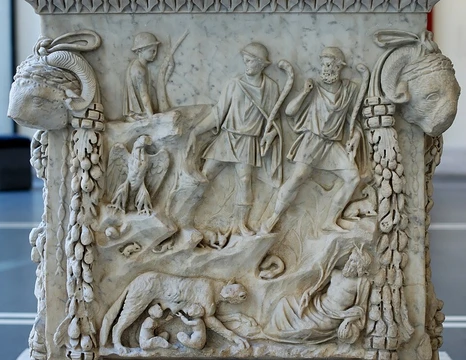
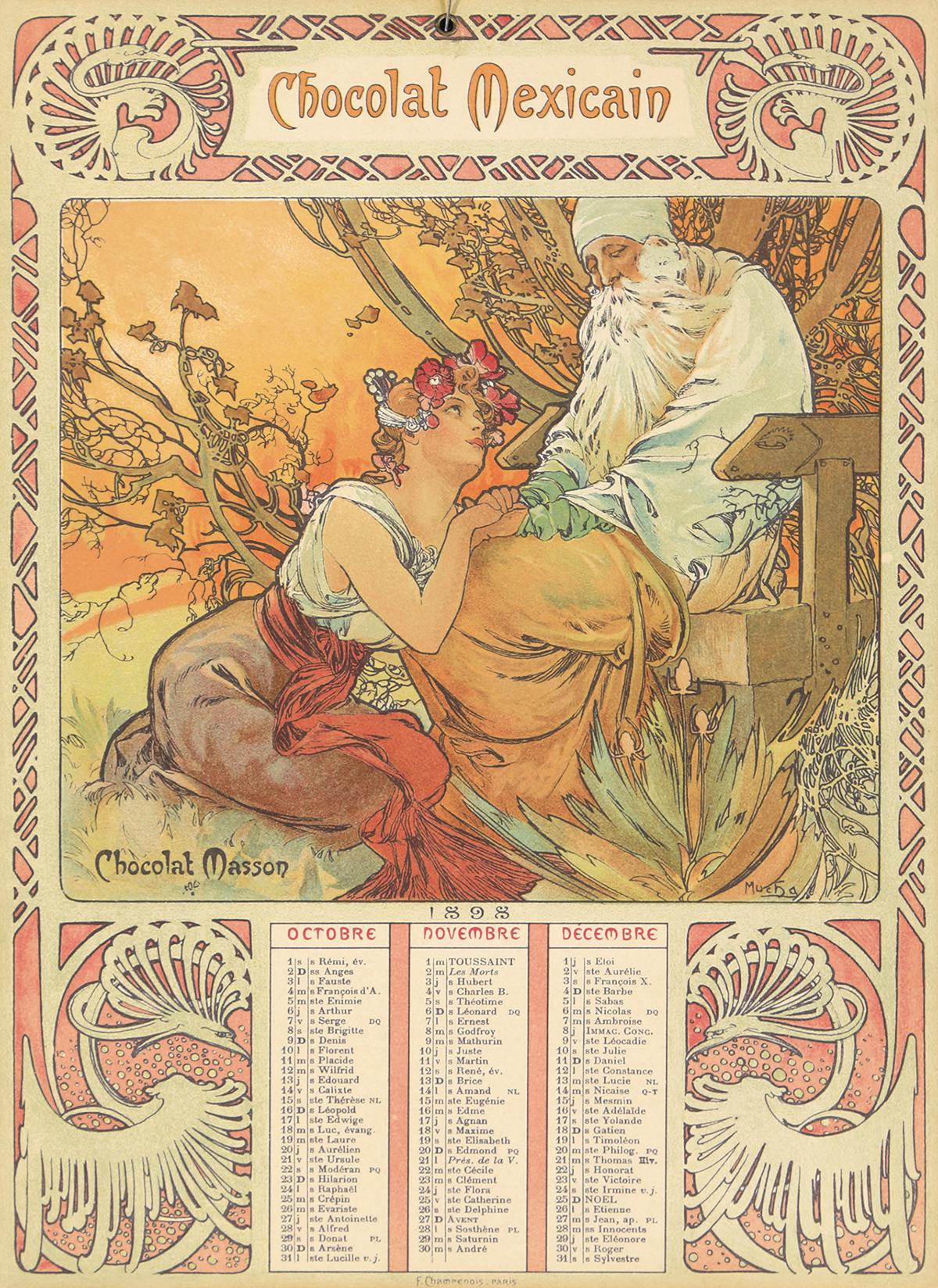
Ages of Man
Mythological stages of human decline from divine to iron.

Alphonse Mucha · Public domain
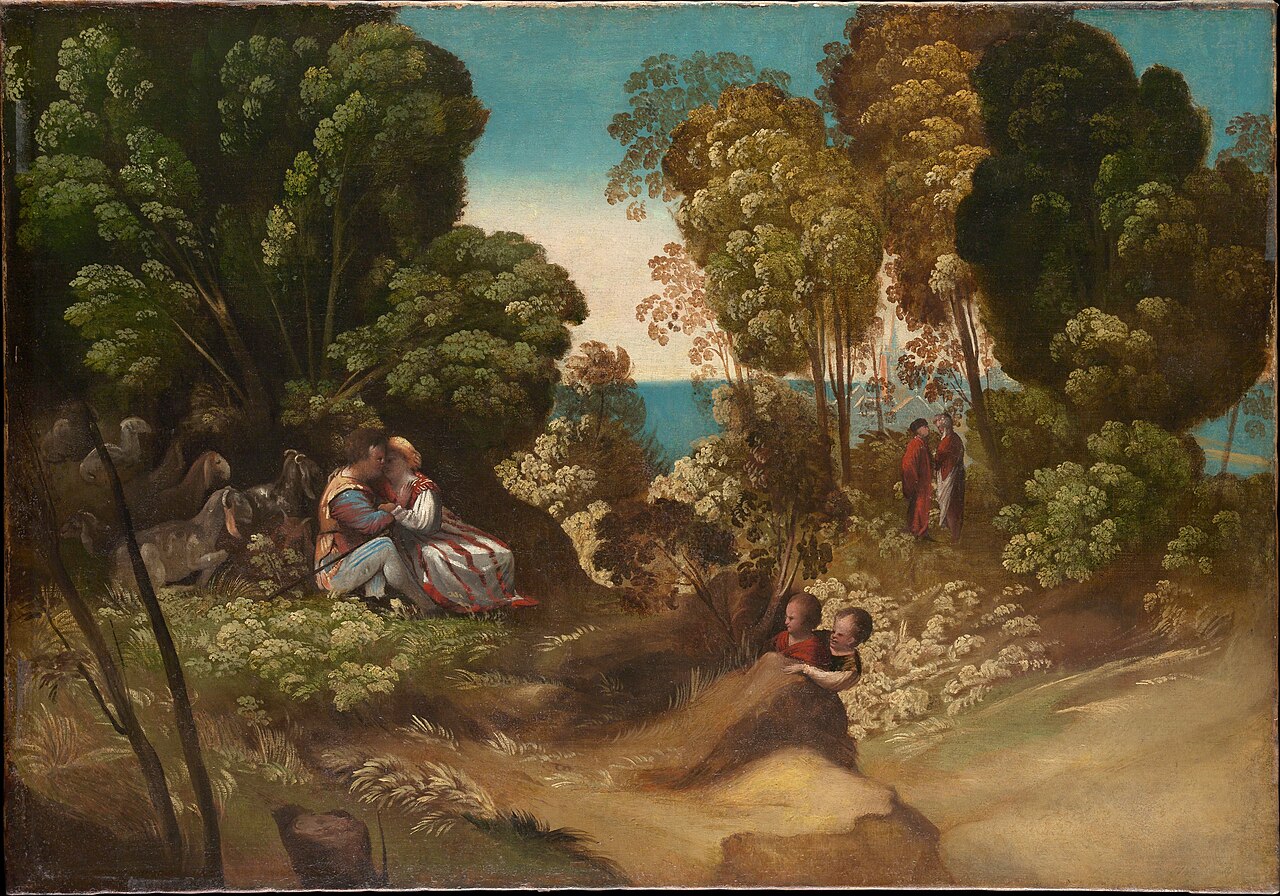
The Ages of Man describe the stages of human history in Greek and Roman mythology. Both the Greek poet Hesiod and the Roman poet Ovid wrote about a sequence of ages that moves from a distant, godlike beginning to the writer’s own time, which is filled with suffering and evil. In the surviving ancient accounts, this decline is symbolized by metals that become less valuable but harder over time.
Hesiod’s Five Ages appear in his poem *Works and Days* (lines 109–201), composed between 750 and 650 BC. The Golden Age occurred under Cronus’s rule. The gods created humans then. Peace and harmony reigned; the earth provided food without labor. People lived to old age while looking young, then died peacefully. The Silver Age began under Zeus, Cronus’s son and successor. Men lived a hundred years under their mothers’ control, then only a short adulthood marked by conflict. They refused to worship the gods, so Zeus destroyed them. After death, they became “blessed spirits” in the underworld. The Bronze Age (also called the Copper or Brazen Age) followed. Zeus made these humans from ash trees. They were hard, tough, and passionate about war and violence. Their armor, homes, and tools were bronze. Their violent nature destroyed them, and they left no named spirits, dwelling instead in Hades’ house. The Heroic Age breaks the metal pattern and is the only age that improves on the one before. Heroes and demigods fought at Thebes during Cadmus and Oedipus’s time and in the Trojan War. They were taken to a land beyond the seas, ruled by Cronus, where sweet fruit grows three times a year, far from the deathless gods. The Iron Age is one of toil and misery. Children dishonor parents, brother fights brother, and guest-host bonds are forgotten. Might makes right, and liars are thought good. At its peak, shame and indignation vanish. Zeus will end this age when babies are born with gray hair and the gods abandon humanity entirely: “there will be no help against evil.” Hesiod places himself in the Iron Age.
Ovid’s Four Ages appear in *Metamorphoses* Book 1.89–150, from the 1st century BC to the 1st century AD. His version resembles Hesiod’s but omits the Heroic Age. In the Golden Age, innocence and justice ruled, and men did not suffer. They did not know navigation or explore the wider world. Agriculture was unknown; they gathered food that fell from trees. The Silve
- Origin
- Greek mythology and Roman interpretation
- Primary sources
- Hesiod's Works and Days (lines 109–201); Ovid's Metamorphoses (Book 1.89–150)
- Hesiod's ages
- Five: Golden, Silver, Bronze, Heroic, Iron
- Ovid's ages
- Four: Golden, Silver, Bronze, Iron (Heroic omitted)
- Symbolic metals
- Gold, silver, bronze, iron (decreasing value, increasing hardness)
- Associated authors
- Hesiod (c. 750–650 BC), Ovid (1st century BC–1st century AD), Plato, Apollodorus, Saint Jerome
Lore & Background
The Greek poet Hesiod (between 750 and 650 BC) outlined his Five Ages in his poem Works and Days. His list begins with the Golden Age under Cronus, where peace and harmony prevailed and humans lived to very old age with a youthful appearance. The Silver Age, under Zeus, saw men living under their mothers for a hundred years, then short adult lives of strife; Zeus destroyed them for impiety. The Bronze Age produced hardened, violent men forged from ash trees, who were undone by their own violence and dwell in the house of Hades. The Heroic Age, which does not correspond to any metal, improved upon the Bronze Age and included heroes who fought at Thebes and during the Trojan War; they were taken to a land beyond the seas ruled by Cronus. The Iron Age is one of toil, misery, and moral decay, where children dishonor parents, might makes right, and Zeus will end the age when babies are born with gray hair. Hesiod finds himself in the Iron Age.
Reader's Guide
The Roman poet Ovid (1st century BC–1st century AD) tells a similar myth of Four Ages in the Metamorphoses, omitting the Heroic Age. Ovid emphasizes that in the Golden Age men did not suffer, did not navigate or farm, but collected food from trees. In the Silver Age, Jupiter introduced seasons, and men learned agriculture and built houses. In the Bronze Age, men were prone to warfare but not impiety. In the Iron Age, men demarcated nations, learned navigation and mining, and became warlike, greedy, and impious; Astraea, goddess of justice, left Earth. Ovid considers the Iron Age to be in the past. Plato in Cratylus clarifies that Hesiod did not mean men literally made of gold, but good and noble; he describes these men as beneficent spirits or daemons. According to Bibliotheca attributed to Apollodorus, the Bronze Age ended with the flood of Deucalion, while Propertius equates the same flood with the end of the Golden Age. Saint Jerome associated the ages with historical timelines, placing the Golden Age c. 1710–1674 BC, the Silver Age 1674–1628 BC, the Bronze Age 1628–1472 BC, the Heroic Age 1460–1103 BC, and considered the Iron Age as still ongoing in the fourth century AD. Modern historical periodisation has reappropriated the terms Bronze Age and Iron Age for archaeological periods, and Golden Age for historical highpoints.
Did You Know?
- Hesiod's Five Ages include a Heroic Age that does not correspond to any metal and is the only age that improves upon the age it follows.
- Ovid's account omits the Heroic Age and considers the Iron Age to be in the past, unlike Hesiod who places himself in the Iron Age.
- Plato in Cratylus clarifies that Hesiod's 'golden race' refers to good and noble humans, not literal gold, and describes them as beneficent spirits or daemons.
- Saint Jerome assigned specific historical dates to the ages, with the Golden Age lasting from about 1710 to 1674 BC and the Iron Age ongoing in the fourth century AD.
Hesiod's Five-Age Descent
The Greek poet Hesiod, writing between 750 and 650 BC, laid out his vision of humanity's decline in lines 109 through 201 of Works and Days. His sequence begins under Cronus's rule with the Golden Age, where the earth freely provided sustenance and humans aged gracefully into peaceful death. Under Zeus, the Silver Age saw men live a century under their mothers' dominion, then a brief adult life marked by conflict and impiety that provoked divine destruction. The Bronze Age, also called the Copper or Brazen Age, brought men forged from ash trees, armored in bronze, consumed by the deeds of Ares. Uniquely, the Heroic Age breaks the metallic pattern and actually improves upon what precedes it, featuring the demigods who fought at Thebes and Troy before being carried to a distant land ruled by Cronus where sweet fruits thrice a year. The Iron Age, in which Hesiod places himself, is defined by toil, familial discord, the collapse of social bonds, and a total loss of shame, with Zeus's ultimate judgment signaled by the birth of gray-haired infants and the gods' complete abandonment of humanity.
Ovid's Roman Reimagining
The Roman poet Ovid, writing in the first century BC or AD, retold the myth in Book 1 of the Metamorphoses, condensing the sequence into four ages by omitting the Heroic Age entirely. His Golden Age is defined by innocence and justice, with men who neither suffered nor possessed the knowledge of navigation or agriculture, gathering food that simply fell from trees. When Saturn was cast into Tartarus, Jupiter introduced the seasons, prompting men in the Silver Age to cultivate the land and build permanent dwellings. Ovid's Bronze or Brass Age men were warlike but notably not impious, a distinction from Hesiod's violent and godless bronze warriors. His Iron Age, however, is far more developed: men draw national boundaries, master navigation and mining, and become greedy and impious, with truth, modesty, and loyalty vanishing entirely. Astraea, the goddess of justice, departs the blood-soaked earth. Crucially, Ovid places the Iron Age in the past rather than his own present, a deliberate departure from Hesiod's self-locating stance.
Philosophical and Scholarly Commentary
Later thinkers and writers engaged with the Ages of Man in varied and sometimes contradictory ways. In Plato's Cratylus, Socrates clarifies to Hermogenes that Hesiod's golden men were not literally metallic but rather good and noble, describing them as daimones, spirits derived from the Greek word for knowing or wise, who served as beneficent guardians preventing ills among mortals. The Bibliotheca, attributed to Apollodorus around the second century BCE, ties the end of the Bronze Age to the flood of Deucalion, while the elegist Propertius, writing around the first century BCE, associates that same flood with the close of the Golden Age instead. The fourth-century scholar Saint Jerome attempted to anchor these mythological stages to a historical chronology, assigning the Golden Age to roughly 1710 to 1674 BC, the Silver to 1674 to 1628 BC, the Bronze to 1628 to 1472 BC, and the Heroic to 1460 to 1103 BC, while treating the Iron Age as still ongoing in his own era.
Legacy and Cross-Cultural Echoes
The mythological framework of the Ages of Man has left an enduring imprint on modern vocabulary and thought. Archaeology's three-age system directly borrows the terms Bronze Age and Iron Age to classify periods following the Stone Age based on predominant metallurgical practices, while the phrase Golden Age has become a standard descriptor for civilizational highpoints, from the Islamic Golden Age to the Han and Tang dynasties of China. Beyond the Western tradition, parallel concepts appear across cultures: the Hindu Yuga Cycle with its four descending ages, the Buddhist Three Ages, the Jain Utsarpiṇī and Avasarpiṇī, the Aztec Five Suns, and Maya creation myths involving successive generations of humanity. In philosophy and literature, Giambattista Vico's ricorso envisions society cycling back to more primitive conditions, J. R. R. Tolkien constructed a fictional Four Ages, and Oswald Spengler developed a civilizational model of rise and decline. The artistic tradition of Lebenstreppe even depicts the ages as ascending and descending steps, while Marx and Engels mapped their modes of production onto a similar progressive schema.
Gallery

Frequently Asked Questions
What are the Ages of Man in Roman mythology?
The Ages of Man is a mythological framework describing humanity's progressive moral and material decline from a godlike beginning to an era of suffering. It was articulated by both the Greek poet Hesiod and the Roman poet Ovid, who each laid out a sequence of successive ages.
How many Ages of Man are there, and what are they?
Hesiod's version in Works and Days names five ages: Golden, Silver, Bronze, Heroic, and Iron. Ovid's account in Metamorphoses trims the list to four by dropping the Heroic age, leaving Golden, Silver, Bronze, and Iron.
What do the metals symbolize in the Ages of Man?
Each successive age takes its name from a metal that is less precious but harder than the one before it. This progression from soft gold to hard iron serves as a metaphor for humanity's increasing coarseness and suffering over time.
What is the primary source for the Ages of Man myth?
The earliest surviving account comes from Hesiod's Works and Days (lines 109–201), composed roughly between 750 and 650 BC. Ovid later adapted and reshaped the sequence in Book 1 of his Metamorphoses during the early first century AD.
Why is the Iron Age considered the worst period?
The Iron Age corresponds to the poet's own contemporary era and is marked by widespread evil, hardship, and the total absence of the peace that characterized the Golden Age under Cronus's rule. It stands as the nadir of the entire decline, with no further age promised beyond it.
More in Roman mythology 1-24
Spotted an error? Know more?
This is a living reference — every entry is fact-audited, and reader corrections feed straight into our audit queue. Suggest an edit · See this site's audit record