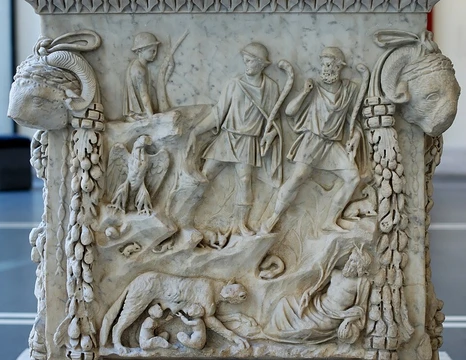
Battle of Lacus Curtius
Final battle in the war between Rome and the Sabines.

The war between Romulus’ Rome and the Sabines began after the Romans abducted Sabine women to marry. The final clash, the Battle of the Lacus Curtius, took place near what would become the Roman Forum.
Before the battle, a Vestal Virgin named Tarpeia—daughter of the Roman citadel’s commander—let the Sabines into the city. Accounts differ on her motive: some say she was bribed with gold bracelets, but the Sabines crushed her with their shields; others claim she tried to trick them and was killed when they suspected her. The armies gathered on the Palatine and Capitoline Hills. The Sabines were led by Mettius Curtius, the Romans by Hostus Hostilius. Recent flooding had left thick mud in the area.
After skirmishes, two pitched battles followed. In the second, Romulus and his ally Lucumo attacked from the wings but had to pull back when the Roman center broke. Mettius Curtius led the Sabine advance. Romulus and Mettius fought directly until Mettius fell wounded. He escaped by plunging into a marshy lake, which stopped pursuit, and later returned to his camp. When a stone struck Romulus’ head, the Romans lost heart and fled. Lucumo was killed by a javelin. Romulus recovered, fresh reserves from the city rallied the Romans, and they pushed the Sabines back. At sunset, the Sabines retreated to the citadel; the Romans stopped chasing.
In Livy’s version, the Romans attacked the hill despite lacking the high ground. After the Roman general Hostus Hostilius fell, Romulus vowed to build a temple to Jupiter Stator if he could stop the Sabine charge and restore courage. He led a rout, and Mettius Curtius was thrown into a swamp by his horse.
The battle continued between the hills, with Rome gaining the upper hand. Then the abducted Sabine women rushed onto the field, standing between the armies. They begged both sides to stop, arguing they were now family. Ashamed, the leaders ended the fighting. Plutarch adds that the women brought food, water, and care for the wounded, and introduced their husbands to their fathers. Afterward, Sabine women had no duty but to spin wool for their husbands.
A peace treaty united the two kingdoms, with administrative power going to Rome. Roman citizens were hence called Quirites, after the Sabine town Cures. The Lacus Curtius was named after Mettius Curtius.
- Commanders
- Romulus and Hostus Hostilius (Romans); Mettius Curtius (Sabines)
Lore & Background
The battle followed Rome's abduction of Sabine women, which sparked hostilities. After Rome defeated three other enemies, the Sabines declared war and spent a year preparing. The Vestal Virgin Tarpeia betrayed Rome to the Sabines, opening the citadel gates; accounts differ on whether she was bribed or tricked, and she was killed by the Sabines. The armies gathered at the Palatine and Capitoline Hills, with the river having recently flooded the area with thick mud. In the battle, the Roman commander Hostus Hostilius was killed by a javelin.
Reader's Guide
The battle featured two pitched battles. In the second, Romulus and Lucumo attacked from the wings but were forced to disengage when the Roman center broke. Mettius Curtius and Romulus fought directly until Mettius fell wounded; he escaped by plunging into a marshy lake. When Romulus was struck by a stone, the Romans lost heart and fled after Lucumo was felled by a javelin. Romulus recovered, and with fresh reserves, the Romans regained the upper hand. The Sabines retreated to the citadel as the sun set. In Livy's account, the Romans attacked uphill after the Sabines refused to engage; Romulus vowed a temple to Jupiter Stator, rallied his men, and routed the Sabines. The battle ended when the abducted Sabine women rushed between the armies, imploring peace. A treaty united the kingdoms, transferring administrative power to Rome. Citizens became known as Quirites after the town Cures. The Lacus Curtius was named after Mettius Curtius.
Did You Know?
- The Vestal Virgin Tarpeia betrayed Rome to the Sabines; accounts differ on whether she was bribed or tricked, and she was crushed by Sabine shields.
- The Sabine general Mettius Curtius escaped capture by plunging into a marshy lake, which later gave its name to the Lacus Curtius.
- The Roman commander Hostus Hostilius was killed by a javelin during the battle.
More in Roman mythology 1-24
Spotted an error? Know more?
This is a living reference — every entry is fact-audited, and reader corrections feed straight into our audit queue. Suggest an edit · See this site's audit record