Ficus Ruminalis
Sacred fig tree of Romulus and Remus' landing.

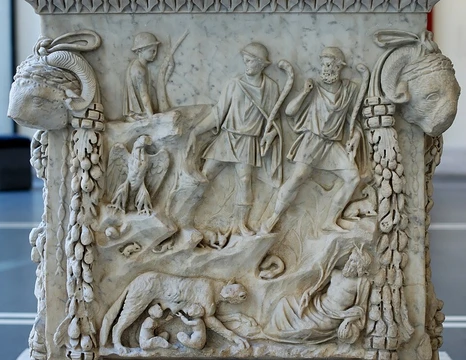
The wild fig tree known as the Ficus Ruminalis held deep religious and mythological importance for ancient Rome. It grew near the Lupercal, a small cave at the base of the Palatine Hill. According to tradition, this was the exact spot where the makeshift cradle carrying Romulus and Remus floated ashore on the Tiber’s banks. There, the she-wolf nursed the twins, and the shepherd Faustulus later found them. The tree was dedicated to Rumina, a goddess of birth and early childhood who oversaw breastfeeding among both humans and animals. Saint Augustine also makes note of a Jupiter Ruminus.
The tree’s name connects it to Rumina, and some Romans linked “Rumina” and “Ruminalis” to *rumis* or *ruma*, meaning “teat” or “breast.” Modern linguists, however, often see a stronger link to the names Roma and Romulus, which may derive from *rumon*—perhaps an old word for “river” or an archaic name for the Tiber itself. The wild fig was considered the male, wild counterpart of the cultivated female fig; in Latin it was sometimes called *caprificus*, or “goat fig.” Its fruit hangs down, and if cut, the tree oozes a milky sap.
In the founding legend, the Ficus Ruminalis marked the place where Romulus and Remus’s cradle landed after they were abandoned. It stood in the Velabrum district, a short distance from the Lupercal. The tree provided shade and shelter for the twins while the she-wolf suckled them just outside the cave, until the shepherd Faustulus and his wife Acca Larentia took them in. Remus later died at his brother’s hand, and Romulus went on to found Rome on the Palatine Hill above the cave.
A statue of the she-wolf is said to have once stood beside the Ficus Ruminalis. In 296 BC, the curule aediles Gnaeus and Quintus Ogulnius added images of Romulus and Remus as infants nursing beneath her teats. This sculptural group may be the one depicted on certain coins. The historian Livy, writing in the Augustan period, records that the tree was still standing in his day. But the poet Ovid, a younger contemporary, mentions only *vestigia*—“traces,” perhaps a stump. A difficult passage in Pliny suggests that the augur Attus Navius miraculously transplanted the tree to the Comitium. That tree, however, was called the Ficus Navia, after the augur. Tacitus refers to the Ficus Navia as the *Arbor Ruminalis*, implying it had replaced the original Ficus Ruminalis—either symbolic
- type
- Sacred tree
- location
- Near the Lupercal, foot of the Palatine Hill, Rome
- associated_deity
- Rumina
- mythological_significance
- Landing site of Romulus and Remus' cradle
- historical_period
- Roman Republic and Empire
- known_for
- Nurturing the twins under a she-wolf
Lore & Background
The Ficus Ruminalis was a wild fig tree, thought to be the male counterpart of the cultivated fig. Its name was connected by some Romans to 'rumis' or 'ruma' meaning 'teat' or 'breast,' though modern linguists suggest a link to 'Roma' and 'Romulus,' possibly from 'rumon,' an archaic name for the Tiber. The tree stood in the Velabrum, a short distance from the Lupercal, where the twins were suckled by a she-wolf and later discovered by the shepherd Faustulus.
A statue of the she-wolf was said to have stood next to the tree. In 296 BC, the curule aediles Gnaeus and Quintus Ogulnius placed images of Romulus and Remus as babies suckling under her teats. The historian Livy reported the tree still stood in his day, but Ovid noted only 'vestigia' (traces), perhaps a stump. A problematic passage in Pliny suggests the augur Attus Navius miraculously transplanted the tree to the Comitium, where it became known as the Ficus Navia. Tacitus identified the Ficus Navia as the Arbor Ruminalis, implying it replaced the original tree either symbolically or as an offshoot.
The Ficus Navia grew from a spot struck by lightning and was considered sacred. When it drooped, it was a bad omen; when it died, it was replaced. In 58 AD, it withered but revived. Archaeological remains at the Comitium include stone-lined shafts that may have preserved venerable trees. A relief on the Plutei of Trajan depicts a fig tree on a plinth, possibly indicating that sacred trees could be replaced with artificial ones.
Reader's Guide
The Ficus Ruminalis holds significance as a living symbol of Rome's foundation myth, linking the city's origins to divine and natural forces. Its association with the she-wolf and the twins Romulus and Remus made it a focal point of Roman religious and civic identity. The tree's sacred status to Rumina, a deity of breastfeeding, underscores the importance of nurturing and fertility in Roman religion. The later Ficus Navia, which may have replaced the original, continued this tradition, with its health interpreted as an omen for the state. The tree's presence in the Comitium, the political heart of Rome, illustrates how myth and ritual permeated public space. The ambiguity in ancient sources—whether the tree was transplanted, replaced, or merely represented—reflects the fluidity of Roman sacred topography. The Ficus Ruminalis thus serves as a case study in how Romans preserved and adapted their foundational legends through physical objects, blending history, religion, and politics.
Did You Know?
- The tree's name may derive from 'rumis' or 'ruma,' meaning 'teat' or 'breast,' or from 'rumon,' an archaic name for the Tiber.
- In 296 BC, the curule aediles Gnaeus and Quintus Ogulnius placed images of Romulus and Remus suckling under a she-wolf statue next to the tree.
- The Ficus Navia, which may have replaced the original tree, grew from a spot struck by lightning and was considered sacred.
- When the Ficus Navia drooped, it was taken as a bad omen for Rome; in 58 AD it withered but revived.
More in Roman mythology 1-24
Spotted an error? Know more?
This is a living reference — every entry is fact-audited, and reader corrections feed straight into our audit queue. Suggest an edit · See this site's audit record