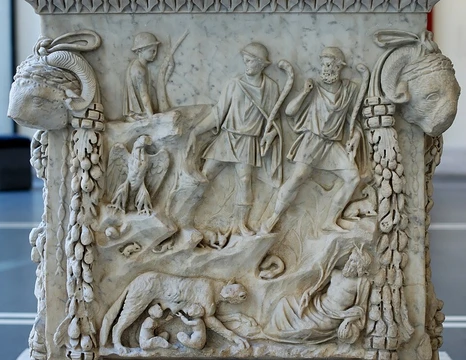
Founding of Rome
Rome's legendary founding by Romulus in 753 BC.

The founding of Rome is the subject of both archaeological evidence and Roman mythology. Archaeological data indicates that Rome developed from the gradual union of several hilltop villages during the Final Bronze Age or early Iron Age, with the earliest settlements on the Palatine dating to around 1000-900 BC. The legendary account, which held that the city was founded by Romulus in 753 BC (or 752 BC), was much discussed and celebrated in Roman times, though most modern historians dismiss it as fiction.
- field
- Ancient history / Archaeology
- known_for
- Legendary founding of Rome, basis of the AUC calendar era
- date_legendary
- 753 BC (Varronian chronology) or 752 BC (Fasti)
- location
- Palatine Hill, Rome
- culture
- Roman / Latin
Lore & Background
Roman myth held that the city was founded by Romulus, son of the war god Mars and the Vestal virgin Rhea Silvia, a fallen princess of Alba Longa and descendant of Aeneas of Troy. Exposed on the Tiber river, Romulus and his twin Remus were suckled by a she-wolf at the Lupercal before being raised by the shepherd Faustulus. They later took revenge on their usurping great-uncle Amulius and restored Alba Longa to their grandfather Numitor. The brothers then decided to establish a new town but quarrelled over details, ending with Remus's murder and the establishment of Rome on the Palatine Hill.
Reader's Guide
The founding of Rome, whether legendary or historical, served as a central cultural touchstone for the Roman state. The Parilia Festival on 21 April was considered to commemorate the anniversary of the city's founding during the late Republic, and that aspect of the holiday grew in importance under the Empire until it was fully transformed into the Romaea in AD 121. The year of the supposed founding was variously computed by ancient historians, but the Varronian chronology's 753 BC date continues to form the basis for most modern calculations of the AUC calendar era, despite known errors in Varro's calculations. Archaeological evidence shows that Rome developed over a long period from the gradual union of hilltop settlements, with the combination into a single polity by the later 8th century BC probably influenced by the trend for city-state formation emerging from ancient Greece. Most modern historians dismiss the ancient accounts of a single founder descended from a Trojan lineage as fiction.
Did You Know?
- Archaeological evidence indicates Rome developed from the gradual union of several hilltop villages during the Final Bronze Age or early Iron Age.
- The Parilia Festival on 21 April was considered to commemorate the anniversary of the city's founding during the late Republic.
- The year 753 BC (Varronian chronology) continues to form the basis for most modern calculations of the AUC calendar era.
- The first evidence of a wall on the Palatine dates between 730 and 720 BC.
More in Roman mythology 1-24
Spotted an error? Know more?
This is a living reference — every entry is fact-audited, and reader corrections feed straight into our audit queue. Suggest an edit · See this site's audit record