Interpretatio graeca
Greek method of equating foreign gods with their own.

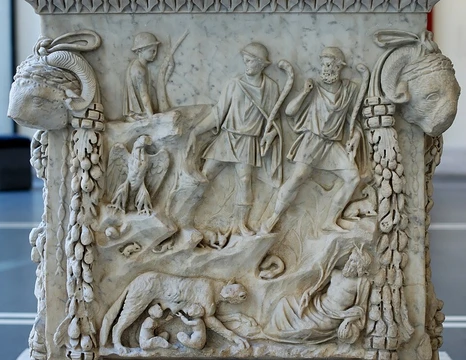
The ancient Greeks had a habit of equating foreign gods with their own, a practice known as *interpretatio graeca*—Latin for "Greek translation" or "interpretation by means of Greek models." This approach served as a way to understand other cultures' religions by mapping them onto familiar Greek deities, myths, and rituals. It could involve Greeks explaining foreign beliefs, as when the historian Herodotus described Egyptian gods in Greek terms (equating Amon with Zeus, Osiris with Dionysus, and Ptah with Hephaestus), or when later writers like Dionysius of Halicarnassus and Plutarch discussed Roman cults using Greek divine names. The concept also applied when non-Greeks reinterpreted their own traditions through a Greek lens, such as the Romans adopting Greek myths and imagery for their own gods.
This comparative method relied on the idea that deities were "translatable" across cultures. Jan Assmann described polytheism's ability to create a shared semantic universe, where gods with similar traits could have their names exchanged. Pliny the Elder noted that different peoples gave different names to the same divine forces. This flexibility fueled the religious syncretism of the Hellenistic era and the pre-Christian Roman Empire.
Herodotus was an early practitioner, drawing Greco-Egyptian parallels that lasted into Hellenistic times. He also linked Scythian deities to Greek ones: Tabiti to Hestia, Papaios and Api to Zeus and Gaia, and Argimpasa to Aphrodite Urania, while noting unnamed equivalents to Herakles and Ares. Some pairings, like Zeus and Jupiter, likely stem from a common Indo-European origin (the sky god Dyeus), but others required more effort. Ares, a minor and often criticized figure in Greek religion, contrasted sharply with Mars, a central Roman father figure. Not all Roman gods had Greek counterparts—Janus and Terminus were unique to Rome—while Apollo was adopted directly but developed distinctly, especially under Augustus. The Etruscans often served as intermediaries, as seen in the linguistic shift from Greek Heracles to Etruscan Her[e]cle to Roman Hercules.
The related term *interpretatio romana* was coined by the Roman historian Tacitus in his *Germania*. He used it to describe Germanic gods he equated with Castor and Pollux, and identified the chief German deity as Mercury (likely Wotan). For the Gauls, who left few written records, Gr
- field
- Comparative religion, mythology
- known_for
- Identifying foreign deities with Greek gods
- related_concept
- Interpretatio romana
Lore & Background
Interpretatio graeca was employed by ancient Greek writers to make sense of foreign religions. Herodotus, one of the earliest authors to engage in this form of interpretation, established Greco-Egyptian equivalents such as Amon/Zeus, Osiris/Dionysus, and Ptah/Hephaestus. He also equated Scythian deities like Tabiti with Hestia, Papaios and Api with Zeus and Gaia, and Argimpasa with Aphrodite Urania. Later, Dionysius of Halicarnassus and Plutarch documented Roman cults under Greek divine names. The practice also extended to non-Greeks, as when Romans adapted Greek myths and iconography under the names of their own gods, forming a distinctive Gallo-Roman religion.
Reader's Guide
Interpretatio graeca was a key mechanism for religious syncretism in the Hellenistic era and pre-Christian Roman Empire. Jan Assmann considered the polytheistic approach to internationalizing gods as a form of 'intercultural translation,' noting that the similarity of gods made their names mutually translatable and produced the conviction that gods are international. Pliny the Elder expressed this 'translatability' as 'different names to different peoples.' The practice allowed Greeks and Romans to absorb and reinterpret foreign deities, though some gods like Janus and Terminus had no Greek equivalent. In the case of the Jewish religion, Roman scholars such as Varro interpreted the monotheistic god as Caelus or Jupiter Optimus Maximus, but Jews rejected such identifications as sacrilege, contributing to friction with the Roman Empire. The legacy of interpretatio graeca is evident in the syncretic compositions of art and the enduring cross-cultural identifications of deities.
Did You Know?
- Herodotus equated the Egyptian god Amon with Zeus, Osiris with Dionysus, and Ptah with Hephaestus.
- The phrase interpretatio romana was first used by the historian Tacitus in the Germania.
- Some pairs of Greek and Roman gods, such as Zeus and Jupiter, are thought to derive from a common Indo-European archetype.
- Roman scholars interpreted the Jewish god as Caelus or Jupiter Optimus Maximus, but Jews rejected such identifications.
More in Roman mythology 1-24
Spotted an error? Know more?
This is a living reference — every entry is fact-audited, and reader corrections feed straight into our audit queue. Suggest an edit · See this site's audit record