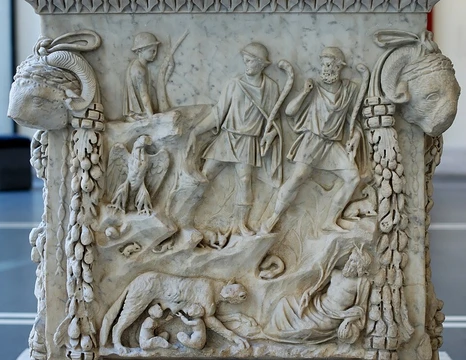
Lacus Curtius
Ancient pit in the Forum Romanum with uncertain origins.

The Lacus Curtius, or "Lake Curtius," was a pit or pool located in the ground of the Forum Romanum. The area where the Forum would later be built was probably once a lake, since the surrounding region was known for its brooks and marshes. One section was never fully drained and gradually shrank until only a basin, the Lacus Curtius, remained. Its purpose and meaning in early Roman history are unclear, and several contradictory tales exist about its origin. The name likely relates to the Curtia gens, a very old Roman family of Sabine origin.
Even the Romans themselves were unsure of the feature's exact history, offering at least three different explanations for its name. Two come from Livy, and one from Varro, listed here in the order the events supposedly occurred.
According to the oldest story, from the 8th century BCE, the Lacus Curtius was named for a Sabine champion, the horseman Mettius Curtius. During the war that followed the Rape of the Sabine Women, he supposedly became stuck in the marsh while fighting. This account is supported by the fact that the Forum was once marshland, that the Curtia gens had Sabine origins, and that the name Mettius is an authentic Sabine word derived from *medìss*, meaning "leader."
A second version, from around 445 BCE and the most straightforward, states that a Roman magistrate named Gaius Curtius Philon consecrated the site after a lightning strike hit it. (Note: No Roman consul by that name is recorded for that year in standard sources, so his exact office remains uncertain.)
The most popular story, from about 362 BCE and the one Livy considered most likely, is a myth glorifying Rome. It tells of a great chasm opening in the Forum, endangering the city. An oracle instructed the people to throw into the chasm "that which constituted the greatest strength of the Roman people," promising that doing so would make Rome last forever. After various objects were dropped in without effect, a young horseman named Marcus Curtius (also of the Curtia gens) realized that *virtus* (courage or virtue) was what the Romans held most dear. He leaped into the chasm in full armor on his horse, the earth closed over him, and Rome was saved. Though clearly epic, this story is unique to Roman tradition and not directly copied from any known Greek tale.
To the east of the Lacus Curtius, some ancient sources mention the discovery of human
- Location
- Forum Romanum, Rome
- Type
- Pit or pool
- Associated family
- Curtia gens
- First recorded story
- 8th century BCE (Sabine war origin)
- Notable figures
- Mettius Curtius, Gaius Curtius Philon, Marcus Curtius
Lore & Background
The exact history of the Lacus Curtius was not well known even to the Romans themselves, and at least three different explanations were given for its name. Two were given by Livy, and another by Varro. According to the oldest story, from the 8th century BCE, the Lacus Curtius was named after a champion of the Sabines, the horseman Mettius Curtius, who got stuck in the marsh during battle following the Rape of the Sabine Women. This is corroborated by the fact that the Forum was once marshland and that the Curtia gens was of Sabine origin.
A second version, from around 445 BCE, says Gaius Curtius Philon, a Roman magistrate, consecrated the site after a lightning strike. (No Roman consul by that name is recorded for that year in standard sources.) The most popular story, from around 362 BCE and deemed most likely by Livy, was a myth: a great chasm opened on the Forum, and an oracle directed
Reader's Guide
The Lacus Curtius holds significance as a physical remnant of the Forum's marshy past and as a focal point for Roman origin myths. Its uncertain history reflects how the Romans themselves struggled to explain ancient features of their city. The three conflicting stories—the Sabine warrior Mettius Curtius, the consul Gaius Curtius Philon consecrating a lightning strike, and the self-sacrifice of Marcus Curtius—each served different cultural purposes: historical, religious, and patriotic. The most popular tale, of Marcus Curtius leaping into a chasm to save Rome, became a symbol of Roman virtus and was later depicted by Renaissance artists such as Paolo Veronese and Lucas Cranach the Elder. Archaeological evidence, including skeletal remains of a bound man, woman, and child found nearby, suggests the legends may be warped recollections of ancient sacrificial drowning rituals or punishments. The site thus bridges Rome's legendary past, its religious practices, and its later artistic legacy.
Did You Know?
- The Lacus Curtius was a pit or pool in the ground of the Forum Romanum.
- The name is likely connected with the Curtia gens, a very old Roman family with Sabine origins.
- At least three different explanations for its name were given by Livy and Varro.
- Skeletal remains of a bound man, woman, and child were found a bit to the east of the Lacus Curtius.
More in Roman mythology 1-24
Spotted an error? Know more?
This is a living reference — every entry is fact-audited, and reader corrections feed straight into our audit queue. Suggest an edit · See this site's audit record