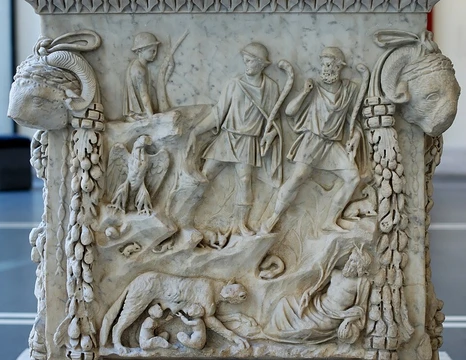
Lupercal
Legendary cave where the she-wolf nursed Romulus and Remus.

The Lupercal, whose name comes from the Latin *lupa* meaning "female wolf," was a cave at the foot of the Palatine Hill in Rome, near the Velabrum. It sat roughly between the Temple of Magna Mater and the church of Sant'Anastasia al Palatino. According to Rome’s founding myth, the she-wolf discovered Romulus and Remus there and nursed them until the shepherd Faustulus took them in. The Luperci—priests devoted to the god Faunus—held rites of the Lupercalia festival at this cave, a practice that continued from the city’s earliest days until it was suppressed by Pope Gelasius I around 494 AD.
In November 2007, Italian archaeologist Irene Iacopi announced that she had likely found the legendary cave under the remains of the Domus Livia, the house of Emperor Augustus's wife Livia, on the Palatine. The discovery came as workers restoring the decaying palace uncovered a cavity 15 meters deep. On 20 November 2007, the first photographs were released, showing a vaulted grotto decorated with colorful mosaics, pumice stones, and seashells. At the center of the ceiling was a white eagle, the emblem of the Roman Empire. Because the grotto’s entrance had not yet been found, the search continued. The location beneath Livia's home was considered significant: before becoming emperor, Octavian had considered taking the name Romulus to signal his ambition to refound Rome.
Some scholars disputed this identification. Adriano La Regina, formerly Rome’s archaeological superintendent and a professor of Etruscology at Sapienza University; Professor Fausto Zevi, a Roman archaeology professor at the same university; and Professor Henner von Hesberg, head of the German Archaeological Institute in Rome, argued against it on topographic and stylistic grounds. They concluded the grotto was actually a nymphaeum or an underground dining room from the Neronian period. Current scholarly consensus holds that the grotto is not the Lupercal, and that the real cave was located farther southwest, nearer to Piazza Sant’Anastasia al Palatino.
- Location
- Foot of the Palatine Hill near the Velabrum, Rome
- Last recorded use
- Suppressed by Pope Gelasius I around 494 AD
- Modern discovery announced
- November 2007 by Irene Iacopi
- Current scholarly consensus
- Not the Lupercal; located lower southwest
Lore & Background
The Lupercal, from Latin lupa meaning 'female wolf,' was a cave at the foot of the Palatine Hill in Rome, near the Velabrum, situated somewhere between the temple of Magna Mater and the Sant'Anastasia al Palatino. According to the founding legend of Rome, the twin brothers Romulus and Remus were discovered there by a she-wolf who suckled them until the shepherd Faustulus rescued them. The cave was also the site of the Lupercalia, ceremonies conducted by the Luperci, priests of Faunus, from the earliest days of the City until the festival was suppressed by Pope Gelasius I around 494 AD.
In November 2007, Italian archaeologist Irene Iacopi announced that she had probably found the legendary cave beneath the remains of the Domus Livia, the house of Emperor Augustus's wife Livia, on the Palatine. Archaeologists came across the 15-meter-deep cavity while working to restore the decaying palace. On 20 November 2007, the first photos were released showing the vault encrusted with colorful mosaics, pumice stones, and seashells, with a white eagle—the symbol of the Roman Empire—at the center of the ceiling. The grotto's entrance had not yet been found.
Reader's Guide
The Lupercal holds a central place in Rome's foundation myth, serving as the cave where the she-wolf nurtured Romulus and Remus, the city's legendary founders. This association made the site a focal point for the Lupercalia, an ancient festival performed by the Luperci priests of Faunus, which continued until at least 494 AD, reflecting the enduring religious and cultural importance of the cave. The location of the Lupercal also carried political significance: Octavian, before becoming Augustus, considered taking the name Romulus to indicate his intention to found Rome anew, and the cave's possible location beneath his residence, the Domus Livia, was seen as symbolically potent.
The modern discovery announced in 2007 by Irene Iacopi generated widespread interest, but subsequent scholarly debate—led by figures such as Adriano La Regina, Fausto Zevi, and Henner von Hesberg—challenged the identification on topographic and stylistic grounds. The current consensus places the Lupercal lower southwest, closer to piazza Sant'Anastasia al Palatino, and identifies the discovered grotto as a Neronian nymphaeum or triclinium. This controversy highlights the difficulty of matching legendary sites with archaeological remains and underscores the Lupercal's lasting legacy as a symbol of Rome's origins, even as its exact location remains uncertain.
Did You Know?
- The name Lupercal comes from Latin lupa, meaning 'female wolf.'
- The Lupercalia ceremonies were celebrated at the cave by the Luperci, priests of Faunus, from the earliest days of the City until at least 494 AD.
- In January 2007, Italian archaeologist Irene Iacopi announced she had probably found the cave beneath the Domus Livia on the Palatine.
- The current scholarly consensus is that the discovered grotto is not the Lupercal, but a Neronian nymphaeum or triclinium located lower southwest.
More in Roman mythology 1-24
Spotted an error? Know more?
This is a living reference — every entry is fact-audited, and reader corrections feed straight into our audit queue. Suggest an edit · See this site's audit record