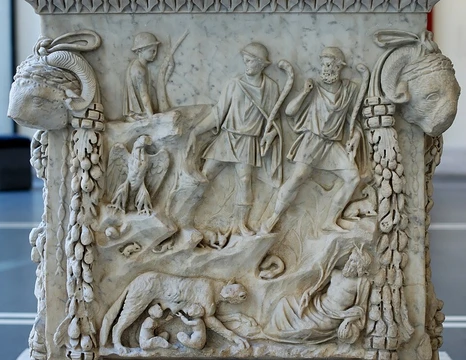
Palus Caprae
Site of Romulus's ascension into godhood in Roman myth.

The Palus Caprae, also known as Capreae (meaning "Goat Marsh" or "the Goat's pool"), was a location in the Campus Martius of ancient Rome. According to Roman mythology, this marsh was the site where Romulus was taken up to become a god.
Fed by the Petronia Amnis stream, the marsh had either vanished or been drained by the Augustan period. It lay in the small basin where the Pantheon was later constructed, to the west of the Altar of Mars, which was traditionally established by Romulus's successor, Numa Pompilius. Scholar Ludwig Preller suggested it might be identical to the Aedicula Capraria listed in Regio VI (Via Lata) by the Regiones. Filippo Coarelli proposed that the mythic importance of the Palus Caprae influenced the choice of location for the Pantheon.
In myth, on the Nones of Quinctilis (July 7), Romulus was reviewing his army on the Campus Martius near the marsh. A sudden storm erupted, accompanied by a solar eclipse, and a flood engulfed the area. When the storm cleared and the frightened Romans emerged from hiding, their king was nowhere to be found. Later, Julius Proculus claimed that Romulus appeared to him in a dream, announcing that he was now to be known as the god Quirinus, having been taken by the gods to live among them. Although Romulus was not said to have died, his tomb was believed to be on the Comitium beneath the Lapis Niger. The event was ritually commemorated by the Nonae Caprotinae.
- location
- Campus Martius, Ancient Rome
- meaning
- Goat Marsh or the Goat's pool
- fed by
- Petronia Amnis stream
- status by Augustan period
- disappeared or drained
- associated myth
- Romulus's ascension into godhood
- commemorated by
- Nonae Caprotinae
Lore & Background
The Palus Caprae was a marsh fed by the Petronia Amnis stream, located in the small basin where the Pantheon was later built, west of the Altar of Mars established by Numa Pompilius. By the Augustan period it had disappeared or been drained. Ludwig Preller thought it might be the same site as the Aedicula Capraria in Regio VI (Via Lata), and Filippo Coarelli conjectured that the mythic significance of the Palus Caprae was the reason for siting the Pantheon there.
In myth, on the Nones of Quinctilis (July 7), Romulus was reviewing the army on the Campus Martius near the Palus Caprae when a storm broke out, accompanied by a solar eclipse, and a deluge consumed the place. When it cleared, the king was nowhere to be found. Julius Proculus later claimed that Romulus appeared to him in a dream and announced he was henceforth to be known as the god Quirinus. The occasion was commemorated ritually by the Nonae Caprotinae.
Reader's Guide
The Palus Caprae holds a central place in Roman foundation mythology as the site of Romulus's apotheosis. Though physically a small marsh that was drained by the Augustan period, its legendary significance may have influenced the placement of the Pantheon, one of Rome's most enduring monuments. The story of Romulus's disappearance during a storm and eclipse, followed by his proclamation as the god Quirinus, provided a divine origin for the Roman state and its cult. The annual ritual of the Nonae Caprotinae kept the memory of this event alive. The site also illustrates how Roman topography blended physical geography with sacred narrative, as scholars have debated its exact location and possible connection to the Aedicula Capraria. The Palus Caprae thus represents a convergence of myth, ritual, and urban development in ancient Rome.
Did You Know?
- The Palus Caprae was fed by a stream called Petronia Amnis.
- Filippo Coarelli conjectured that the mythic significance of the Palus Caprae was the reason for siting the Pantheon there.
- Romulus's disappearance at the Palus Caprae was commemorated ritually by the Nonae Caprotinae.
- Julius Proculus claimed that Romulus appeared to him in a dream and announced he was to be known as the god Quirinus.
More in Roman mythology 1-24
Spotted an error? Know more?
This is a living reference — every entry is fact-audited, and reader corrections feed straight into our audit queue. Suggest an edit · See this site's audit record